What Trading Costs Actually Include
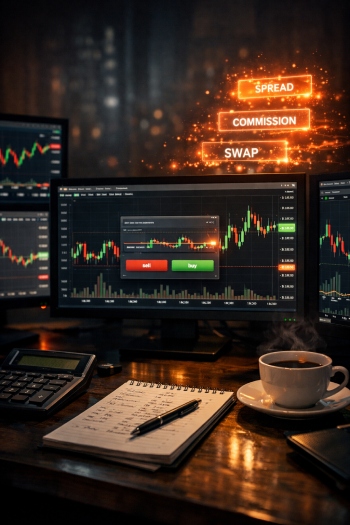
You need to earn back every dollar you spend in or out of a trade to get a profit somewhere down the line. Trade costs are simply the first obstacle a trade must jump.
Most retail traders consider whether the entry was right. They pay little attention to what they got charged for entry, holding it overnight, or closing the trade days later. The detailed list accounts for more than what many would expect.
Direct Costs You'll See on the Trade Ticket
The spread is the most immediate cost. It's the gap between the buy price and the sell price, and you're on the wrong side of it the moment you enter. On EUR/USD, a 1-pip spread on a standard lot costs $10 - before the market moves a single tick in your favor.
Commissions are charged separately on some account types, typically as a flat fee per lot or per side. A broker might charge $3.50 per side, meaning $7 round-trip per standard lot.
Slippage isn't a fee exactly, but it costs real money. During fast markets or low liquidity, your order fills at a worse price than expected. A trader targeting a 10-pip scalp who slips 2 pips on entry and exit has quietly lost 40% of their intended gain.
Costs That Show Up Later
Overnight funding, often called swap fees, applies when you hold a leveraged position past the daily rollover. These can run $5 to $15 per standard lot per night depending on the instrument and rate differential - which adds up fast on multi-day trades.
Less obvious charges include currency conversion fees when your account denomination differs from the traded instrument, inactivity fees that kick in after 90 days without a trade on some platforms, and withdrawal charges that quietly reduce what you actually receive.
- Direct costs: spread, commission, slippage
- Indirect costs: overnight funding, currency conversion, inactivity fees, withdrawal fees, market data subscriptions
A marginal trade that looks profitable at face value can easily turn negative once all of these are accounted for.
Platform and Execution-Related Costs
Beyond visible fees, the quality of execution itself can introduce hidden costs. Some brokers route orders differently depending on account type, liquidity providers, or internal risk management. This can affect fill speed, price accuracy, and how often slippage occurs.
Latency, requotes, and partial fills may not appear as line-item charges, but they influence real outcomes, especially for short-term traders. A platform that consistently delays execution by even a fraction of a second can lead to systematically worse entries and exits. Over time, this becomes a measurable cost, particularly in volatile or fast-moving markets.
How Spreads and Commissions Shape the Real Price of a Trade
When you begin a trade, it does so at a loss. Extremely pessimistic? Maybe not. That's just the way the game is played. When purchasing some currency pair or CFD, you pay the spread. The spread is the difference between the price the broker would sell to you (the ask) and the price the broker would buy from you (the bid). Here is an example. If EUR/USD displays the bid at 1.0999 and an ask of 1.1001, your direct cost is 2 pips. The market would need to move favorably in your direction just for a break-even point to be reached.
Spread-Only vs. Commission-Based Accounts
Some brokers fold everything into the spread. Others charge a tighter spread but add an explicit commission per trade or per lot. Neither model is automatically cheaper. Take a forex broker offering EUR/USD at 1.2 pips with no commission versus one offering 0.2 pips plus $7 per round turn on a standard lot. On a single standard lot trade, the first costs roughly $12 in spread; the second costs around $9 total. The commission-based account wins - but only if your position size justifies it. On a micro lot, that $7 flat fee would be disproportionately expensive.
Fixed vs. Variable Spreads and Who They Suit
Spreads aren't always stable. Variable spreads can widen sharply during news events, low liquidity periods, or market open volatility - sometimes tripling in seconds. Fixed spreads stay constant regardless of conditions, which sounds appealing, but brokers typically set them wider to absorb that risk. Scalpers, who open dozens of trades daily and profit from tiny moves, are hit hardest by any spread widening. A 3-pip spread on a 5-pip target trade destroys the math entirely. Swing traders holding positions for days care less about the spread and more about overnight funding charges, which is a different cost conversation altogether.
The Hidden Fees Many Traders Notice Too Late
Spreads and commissions show up on every broker's homepage. The fees that quietly drain your account are buried three pages deep in the product disclosure statement.
Overnight funding is probably the most common surprise. When you hold a leveraged CFD position past the daily rollover - usually around 10pm or 11pm platform time - your broker charges a financing fee based on the notional value of the trade, not your margin. Hold a $10,000 position for five nights and that cost adds up fast. Some traders run strategies where they hold positions for weeks without realizing they're paying daily interest the entire time.
Slippage is different because it doesn't appear on any fee schedule. During fast markets - a surprise Fed announcement, an earnings miss, a flash crash - your order fills at a worse price than requested. A market order placed at 1.1050 might execute at 1.1058. That eight-pip gap is real money, and it happens most when you can least afford it.
Currency conversion fees catch traders who fund their account in one currency and trade instruments denominated in another. Profit or loss on a US-denominated stock, for example, gets converted back to British pounds at your broker's exchange rate, not the interbank rate. That margin can be 0.5% to 1% per conversion.
Other fees worth hunting down before you open an account:
- Inactivity fees: typically $10–$25 per month after 3–12 months of no trading
- Withdrawal fees: some brokers charge per bank transfer, especially internationally
- Wider spreads during off-hours: EUR/USD at 3am on a Sunday can be three times the daytime spread
- Data or platform fees: waived only if you meet a monthly trading volume threshold
Check the broker's full fee schedule, the product disclosure document, and the account terms separately. Marketing pages rarely show the complete picture.
How to Measure Costs and Choose a Lower-Cost Broker
Before you fund an account, run a simple calculation: take the typical spread in pips, add any commission per lot, then convert that total into a percentage of your average trade size. That single figure is your effective cost per trade. A broker advertising a 0.8-pip spread on EUR/USD looks cheap until you notice the $7 round-turn commission that pushes your real cost to 1.5 pips equivalent on a standard lot.
A Practical Pre-Account Checklist
Start with your trading style. Scalpers and high-frequency traders need raw or ECN accounts with tight spreads and low commissions because they open dozens of trades daily. Swing traders holding positions for days should prioritize overnight funding rates over headline spreads. Check whether your preferred instruments have wide spreads at the times you actually trade. EUR/USD at 9 AM London is a different product from EUR/USD at 2 AM Sydney time.
Leverage use matters here too. Holding a leveraged position overnight multiplies your swap exposure. A trader carrying five lots of AUD/JPY through a weekend can absorb three days of overnight fees in a single charge. Account currency is another quiet cost. If your account is in USD but you trade GBP pairs, conversion fees apply on every settlement.
Reducing Costs in Practice
Trade during peak liquidity hours, roughly 8 AM to 12 PM London time, when spreads compress naturally. Monitor slippage by comparing your requested price to your filled price over 20 to 30 trades. Consistent negative slippage of even 0.3 pips per trade adds up to hundreds of dollars monthly on active accounts.
Read the full fee schedule before depositing, not just the trading page. Withdrawal fees, inactivity charges, and custody fees for stock CFDs all appear in the small print.
There's no denying that the broker with the lowest advertised spread often isn't the cheapest once execution quality, hidden charges, and overnight costs enter the picture.
Small Fees Can Make a Big Difference
Every cost paid in entering and exiting a trade fits as a direct deduction from your bottom line, so that spread on the screen you see may only come as quite a part of the full picture. Commissions and excess charges, as well as overnight funding fees admin costs, charges for currency conversions and inactivity per day, cannot fail to mount up as a constant pull weighing out a previously sound strategy.
One would best group spreads, commissions, and other hidden costs together as an integrated charge rather than as independent expense items-because that is precisely how they affect your account. Put that cost structure to the very way you actually trade - meaning that a temporal scalper making a zillion trades every day will be terribly sensitive to razor-thin spreads and lowest commissions, while another trader who holds positions for several days will, most importantly, consider overnight funding rates. Really scrutinizing prospects in advance can be beneficial-looking at charges with regard to more dimensionality first, rather than later. Once your funds hit the account, with every single trade, promptly figure out the all-in cost structured against tracking numbers to help achieve improved outcomes without changing your strategies one tiny bit.
Search
With the kind help from