Understanding Financial Markets
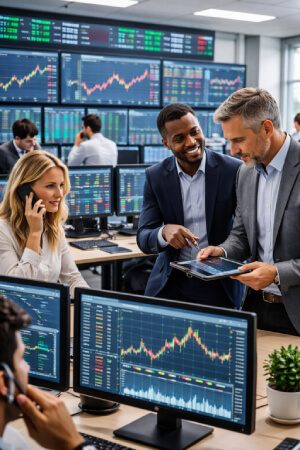
To facilitate the buying and selling of assets, financial markets are made. In essence, the markets provide a structured environment through which prices are determined. These prices embody signals; they are the combined champions of values, growth, risk or scarcity. While the mechanics are intricate, the objective itself is simple: finding the people who want to pass risk or capital to the person willing to absorb it.
Primary and Secondary Markets
Financial instruments often begin their life in primary markets, where new securities are issued. This is where companies raise capital by selling shares or governments issue bonds to fund public spending. Investors in primary markets provide funds directly to the issuer, usually with long-term objectives in mind.
Secondary markets are where most trading activity occurs. Here, existing instruments are bought and sold between participants, sometimes many times over. Prices fluctuate based on news, performance, and broader economic conditions. These markets provide liquidity, allowing investors to enter or exit positions without dealing directly with the original issuer.
Centralized and Decentralized Trading
Some markets operate through centralized exchanges, which set standardized rules and listing requirements. These environments often offer higher transparency and oversight, with prices visible to all participants. Centralization can improve trust but may limit flexibility.
Other markets are decentralized, relying on networks of dealers or electronic platforms rather than a single exchange. Prices may vary slightly between venues, reflecting differences in liquidity and demand. Decentralized markets often allow broader participation but can require more careful evaluation of counterparties and execution quality.
Market Participants and Roles
Participants in financial markets serve different functions. Hedgers seek to reduce exposure to risk, such as companies protecting against currency fluctuations. Speculators aim to profit from price movements, accepting risk in pursuit of returns. Investors typically focus on longer-term value, while arbitrageurs exploit price discrepancies across markets.
Each role contributes to market dynamics. Hedging activity can stabilize prices, speculation can add liquidity, and arbitrage helps align prices across platforms. Understanding these roles helps explain why markets behave differently during periods of calm versus uncertainty.
Major Categories of Tradable Instruments
Tradeable instruments consist of various claims, contracts, and/or exposures, and although assortment may seem overwhelming, most instruments fall broadly under a few generic groups that emphasize the nature of their respective industries. These groups hence represent distinct economic forces and interrelationships and hold certain risk features.
While looking at trading opportunities, crossing a variety of instruments in several portfolios happens, where participants calibrate the optimal asset allocation between the various asset types, regions, and time horizons. Usually, trading platforms present notable groups of instruments merely for convenience and endowment.
Equities and Ownership Instruments
Equities represent ownership in a company. When an investor buys a share, they acquire a claim on part of the company’s assets and future earnings. Equity prices reflect expectations about profitability, growth, and management effectiveness, as well as broader market sentiment.
Equities can generate returns through price appreciation and, in some cases, dividends. They also carry higher risk compared to many other instruments, as shareholders are last in line if a company fails. Market volatility, earnings reports, and economic cycles all influence equity valuations.
Debt Instruments and Fixed Income
Debt instruments involve lending money in exchange for interest payments and the return of principal at maturity. Bonds issued by governments, corporations, or other entities fall into this category. The perceived creditworthiness of the issuer plays a major role in determining interest rates.
Fixed income instruments are often seen as more stable than equities, but they are not risk-free. Changes in interest rates, inflation expectations, and issuer credit quality can affect prices. These instruments are commonly used to generate predictable income or reduce overall portfolio volatility.
Derivatives and Contract-Based Instruments
Derivatives derive their value from an underlying asset, index, or rate. Common examples include futures, options, and swaps. These instruments allow participants to hedge risk or speculate without owning the underlying asset directly.
Because derivatives involve leverage and small price movements can lead to significant gains or losses. This makes them powerful but potentially dangerous tools. Understanding contract terms, expiration dates, and margin requirements is essential before engaging with derivative markets.
Currencies and Foreign Exchange Markets
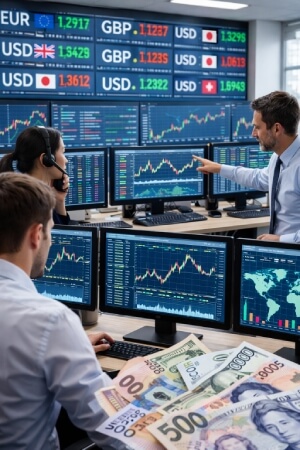
The foreign exchange market is one of the largest and most liquid financial markets in the world. It enables the exchange of one currency for another, supporting international trade, investment, and travel. Currency prices reflect relative economic strength, interest rates, and geopolitical stability.
Major, Minor, and Exotic Currencies
Major currencies are those most frequently traded and typically belong to large, stable economies. These currency pairs tend to have higher liquidity and lower transaction costs. Minor currencies involve less commonly traded pairs but still represent established economies.
Exotic currencies belong to smaller or emerging markets. Trading these instruments can offer higher potential returns but often comes with increased volatility and lower liquidity. Price movements may be influenced by political developments or economic imbalances.
Factors Influencing Currency Prices
Interest rate differentials are the most important of these factors--for example, if one country faces higher interest rates than another, then investing in its currency is likely to be very an attractive course of action. Inflation, trade balance, and economic growth expectations also play very important roles also.
Political stability and central bank credibility are two major factors in a currency's credibility. Unexpected policy changes, such as geopolitical tensions, can at times cause quite pronounced price movements. Successful trading in currencies is often a matter of following closely the market indicators as well as the signals of policy.
Uses of Currency Trading
Currency trading is not limited to speculation. Businesses use foreign exchange markets to hedge against exchange rate risk when operating internationally. Investors use currencies to diversify portfolios or gain exposure to global economic trends.
For individuals, currency trading offers access to a dynamic market but requires disciplined risk management. Leverage amplifies both gains and losses, making careful position sizing essential.
Indices as Market Benchmarks
Groups are created to track the overall movements of certain specific economic activities in the stock market by the financial market. This is effectively a benchmark for the market, reflecting the aggregate performance of a particular class of securities.
Upon having an index, traders enjoy exposure to broader trends based on a single position. This situation ensures the reduction of individual company risks while capturing systemic market moves. Indices are traded at an exceptional rate by both investors and traders.
Construction and Purpose of Indices
An index is constructed by selecting a set of assets and assigning weights based on criteria such as market capitalization or price. The methodology determines how changes in individual components affect the overall index value.
Indices provide a reference point for performance measurement. Fund managers compare returns against relevant indices, while policymakers and analysts use them to gauge economic conditions.
Trading Index-Based Instruments
Indices themselves cannot be traded directly, but various instruments provide exposure to their movements. These include futures, options, and exchange-traded products. Trading platforms often list indices alongside other instruments for easy access.
Index trading can be useful during periods of uncertainty, as it reflects collective market sentiment. However, it still carries risk, particularly during sharp market downturns or periods of heightened volatility.
Global and Regional Indices
Some indices represent global markets, combining assets from multiple countries. Others focus on specific regions or industries. This variety allows participants to tailor exposure based on geographic or sectoral views.
Understanding what an index includes is critical. Composition changes, rebalancing, and methodological updates can affect performance over time.
Commodities and Physical Resources
Commodities represent raw materials and basic goods used in production and consumption. Trading these instruments provides exposure to supply and demand dynamics that differ from those affecting financial assets like stocks and bonds.
Energy and Industrial Commodities
Energy commodities include resources used to power economies. Their prices often respond to geopolitical developments, production agreements, and changes in global demand. Industrial commodities, such as metals, are closely tied to construction and manufacturing activity.
These commodities are sensitive to economic cycles. Strong growth can increase demand and push prices higher, while slowdowns may reduce consumption and lead to price declines.
Agricultural Commodities
Climate and consumption trends have an impact on agricultural goods and, in being weather-dependent, a supply disturbance can lead to sharp fluctuations in prices, which certainly implies a sensitivity to environmental factors.
The art of trading agricultural commodities entails understanding the crop calendar, production cycles, and storage criteria. Prices vary usually due to what feed prices to go up - expected future harvests - rather than all due to only current supply considerations.
Precious Metals as Stores of Value
Precious metals are often viewed as stores of value, especially during periods of economic uncertainty. Their prices can reflect inflation expectations, currency strength, and investor sentiment.
While sometimes seen as defensive assets, precious metals still experience volatility. Understanding their role within a broader portfolio helps set realistic expectations about performance.
Other Market Instruments and Products
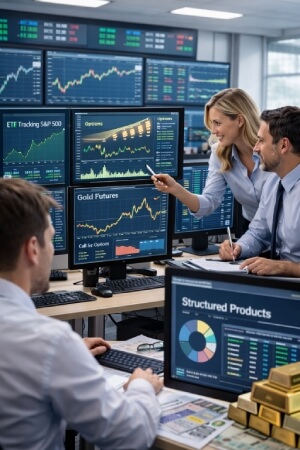
Relying on larger asset classes, trading platforms provide specific instruments for special tasks. These products may have differing conditions, with respect to multiple asset classes, or may deliver a specific kind of exposure.
Innovation in financial markets keeps developing the range of products available worldwide. Although it offers options and opportunities, this pretty much brings the topic of product structure and risks to the fore.
Exchange-Traded Products
Exchange-traded products are designed to track the performance of an underlying asset or index. They trade on exchanges like individual securities, offering transparency and ease of access.
These products can simplify diversification but still carry risks related to market movements and tracking accuracy. Reviewing product documentation is essential to understand how returns are generated.
Structured Products
Complexity is an unavoidable when it comes to structured products. Regarding structured products, the underlying assets are, by their nature, negotiable. This makes it possible to trade this class of products on exchanges or over-the-counter, making it difficult to comprehend because of the multiple trading rules.
Final Thoughts: Navigating the Market Landscape
Financial markets bring multitudinous tradable instruments each a small reflection of different sides of the global economy. Some of these instruments are tradeable asset classes like FX, equities, or commodities; some are well-known financial derivatives. The instruments in this context are the mechanisms by which financial agents share risks, express views, allocate capital.
Search
With the kind help from